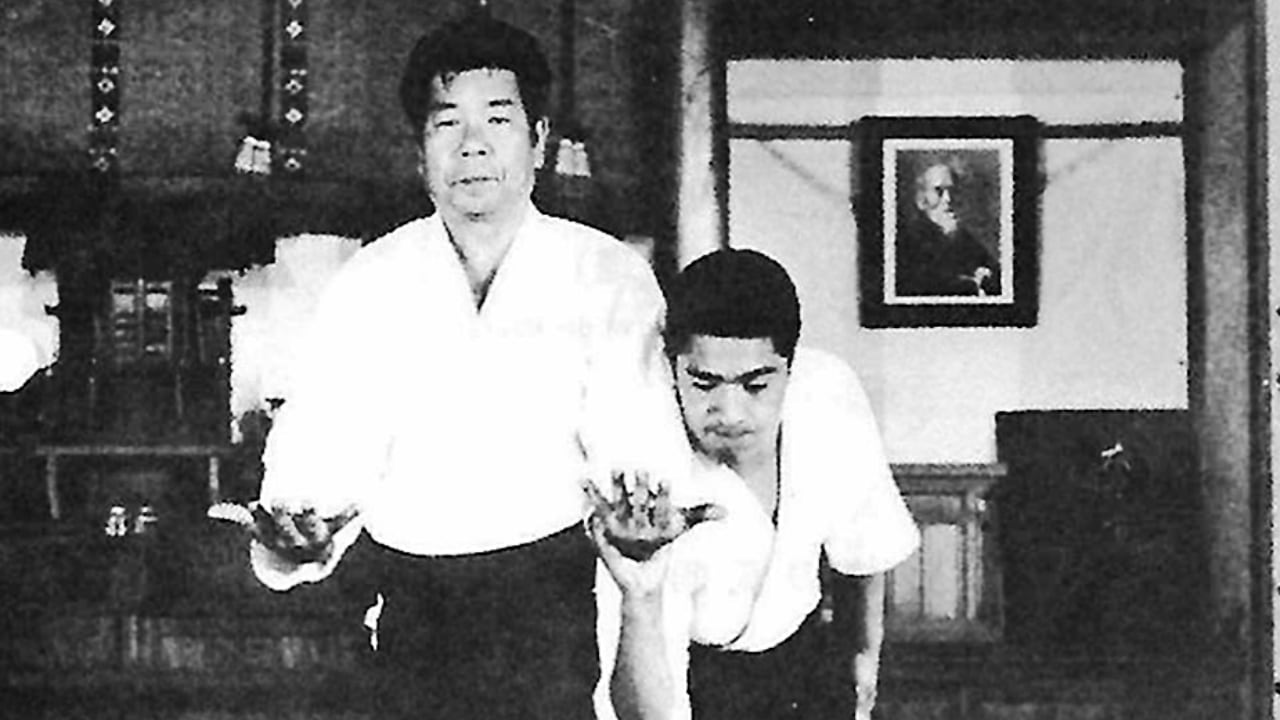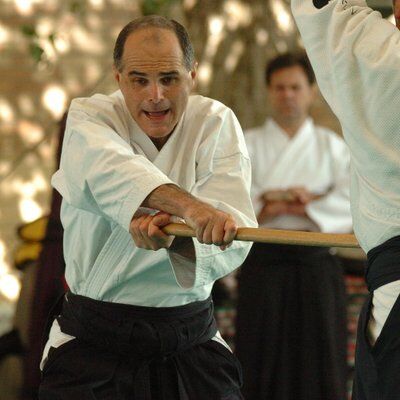
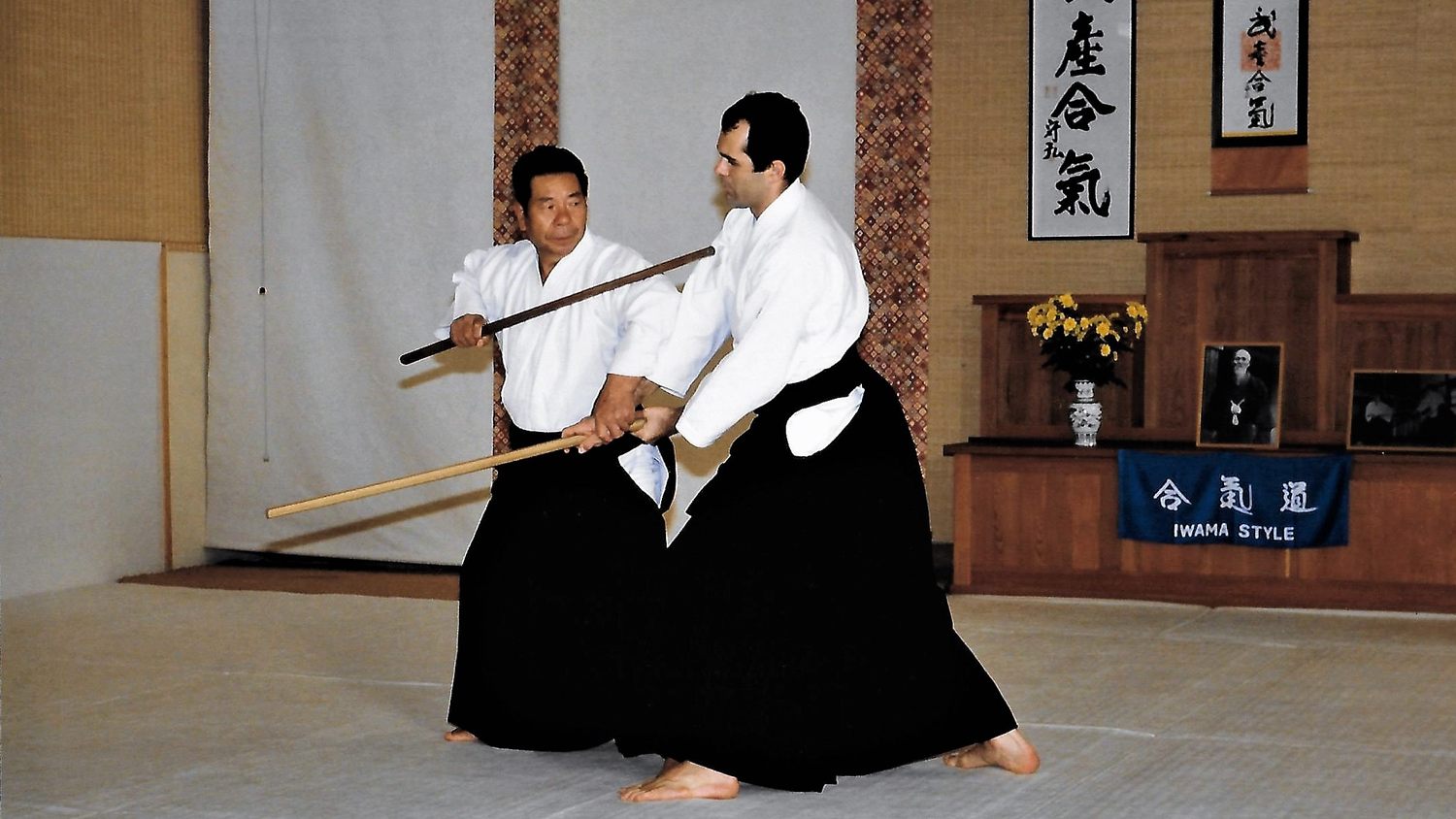
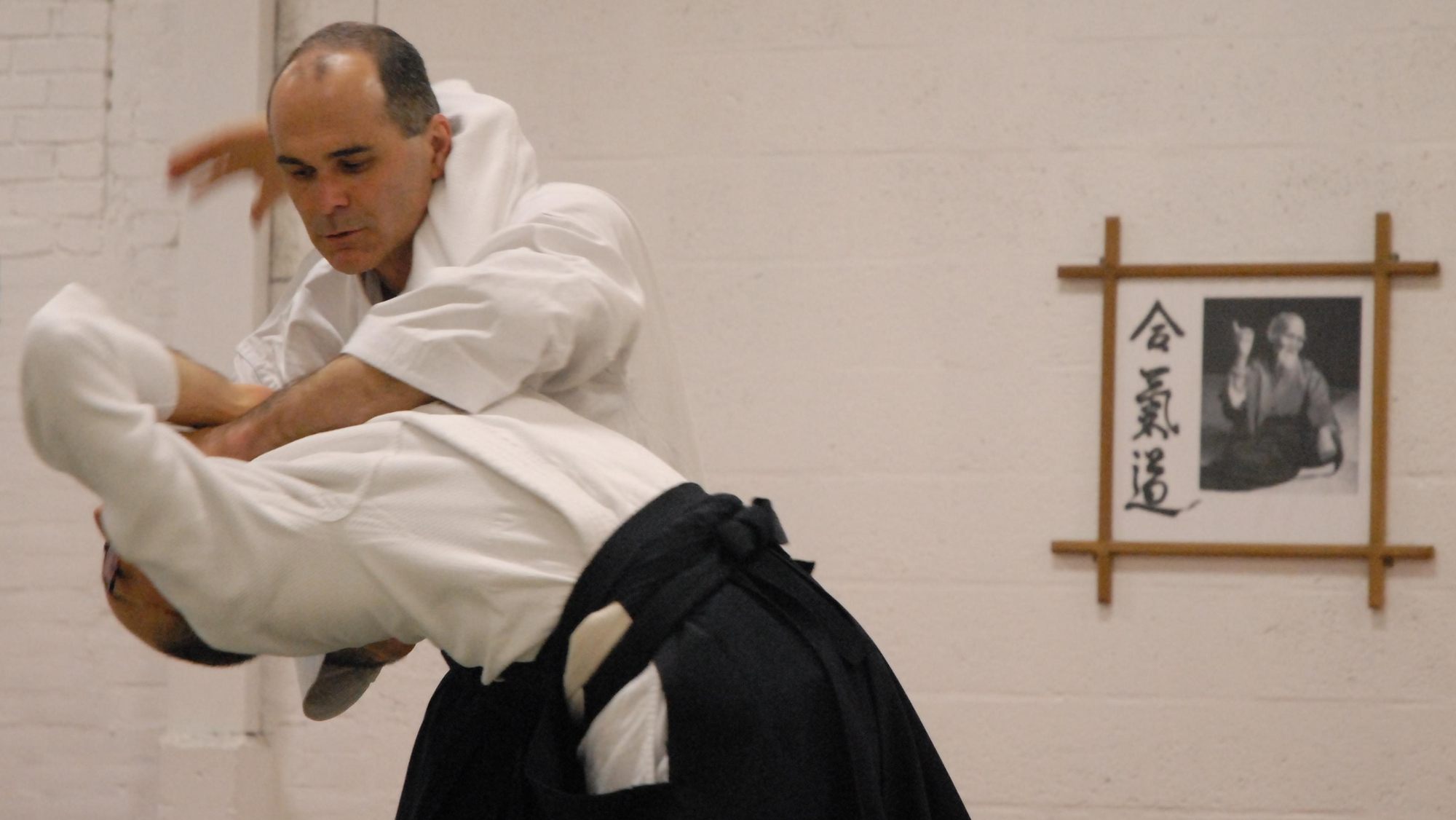
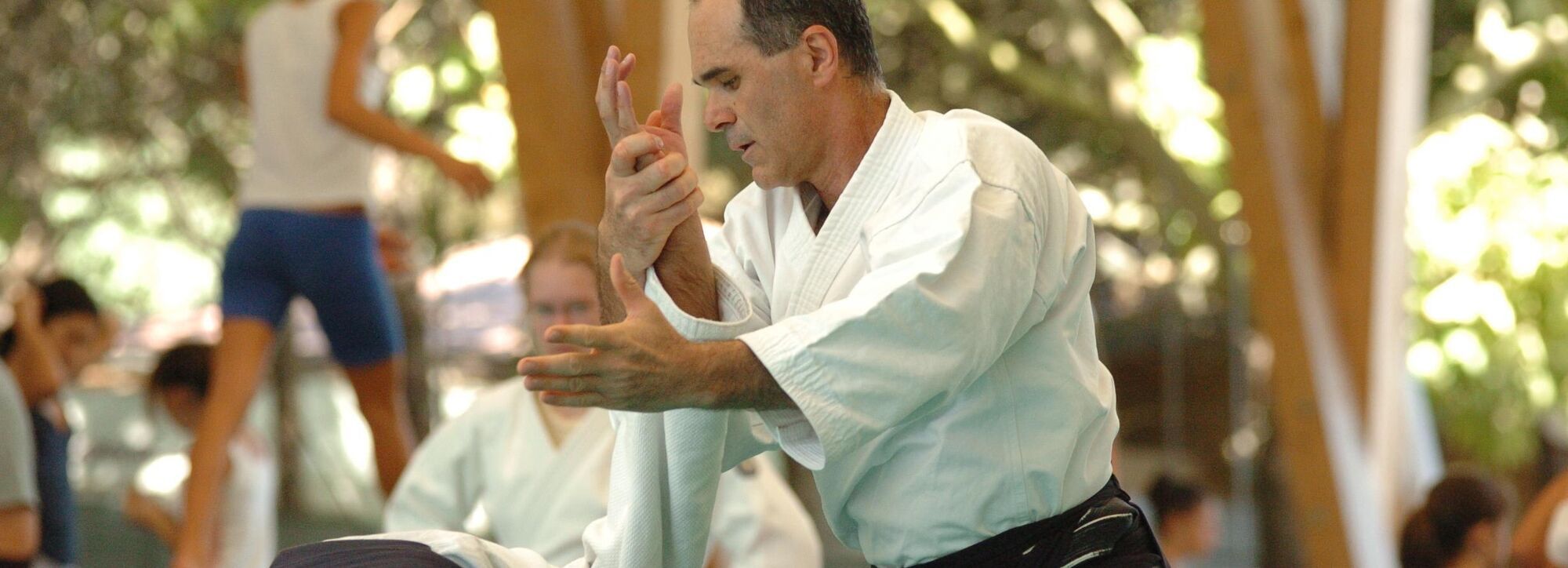
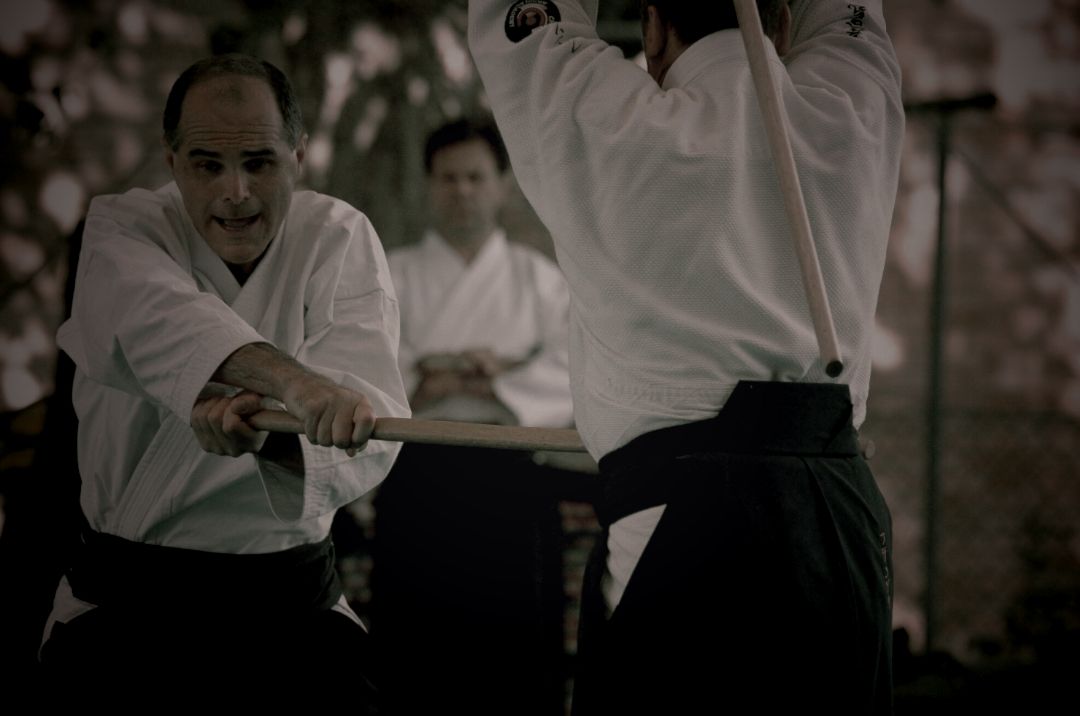

When the opponent rises shomen, whether empty handed or wit h a sword, open and rise the front arm. This allows you to synchronize your movements. Even more, by sending forward the front part of your body, you make the back side disappear, thanks to the rotation.

Bring down your arm, following uchi tachi's rhythm.

Grab the sword from the top, between uchi tachi's hands.


Grab the back of the sword as shown, taking care not to tighten your grip. Uchi tachi must already be unbalanced on his right.

With a tenkan which brings your left leg backward, take the sword by cutting gyaku kesa giri. That lever snatches the weapon from uchi tachi's hands. If you don't respect that angle when you bring the handle up, taking the weapon is impossible.
.

Uchi tachi steps back to protect his face.
Aikido is not a sport, it is a martial art which laws (takemusu) are in harmony with the laws of the universe. Studying them allows the practitioner to understand his place in the universe. Aikido was born in Iwama, O sensei achieved in that village the synthesis of tai jutsu, aiki ken and aiki jo.
The International Takemusu Aikido Federation (ITAF) brings to the practitioner the structure he needs in order to work as close as possible to the reality O sensei MU defined. The official national representations are the guarantee of a teaching faithful to the Founder's.
In modern Aikido, weapons are hardly taught, if taught at all. In O sensei's Aikido, on the contrary, aiki ken, aiki jo and tai jutsu are unified and form together a riai, a family of harmonious techniques stemming from one unique principle. Each techniques helps understand all the others.
Peace is a balance between a human being and the world around him. The true martial art's goal is not to become stronger than one's opponent but to find in that opponent a way to realize harmony. There is no enemy anymore as such, but an opportunity offered to reach unified ki.